
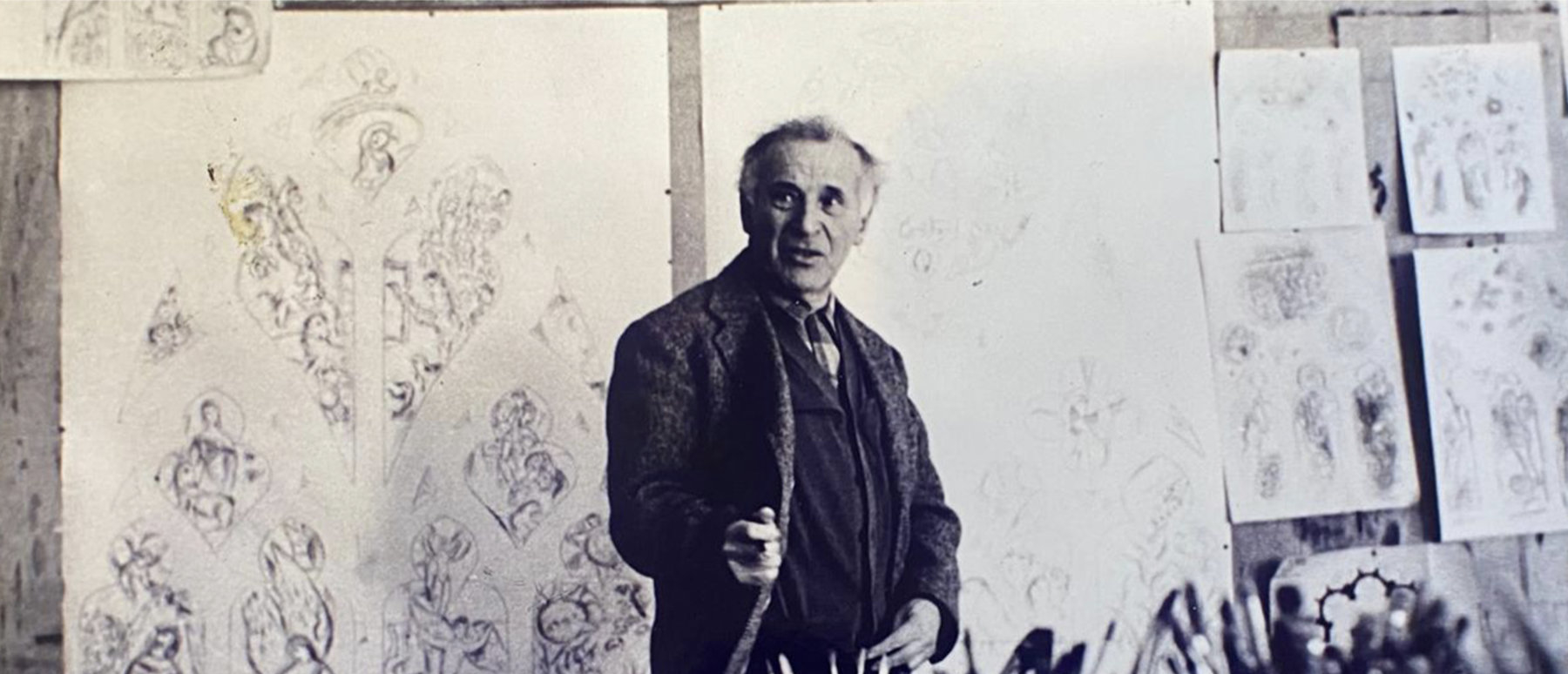
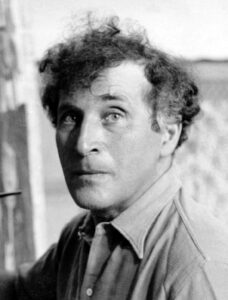
Marc Chagall (1887–1985) was a Russian-French artist of Jewish origin, born in Vitebsk, Belarus, when it was still part of the Russian Empire. He is recognized as one of the most influential figures of 20th-century Modernism. Chagall excelled in various areas, including painting, illustration, stained glass, ceramics, tapestry, and set design. His work engages with both modern avant-garde movements and Jewish cultural tradition, and he earned the admiration of contemporaries and artists of subsequent generations, despite the difficulties he faced throughout his life.
The Institute bears his name for two main reasons: first, because of the significance of his work, which uniquely depicted Jewish life in Russia in the late 19th and early 20th centuries; and second, because the year of his death, 1985, coincided with the Institute’s founding, lending the tribute an even more symbolic character.
The Life of Marc Chagall
Marc Chagall was born in 1887 in Tsarist Russia, in the city of Vitebsk, located in a region known as the “Pale of Settlement,” where Jews were allowed to live alongside the local Christian population. This area encompassed Belarus, Ukraine, Poland, and Lithuania. Vitebsk had about 50,000 inhabitants, half of whom were of Jewish origin, and featured a cathedral and a church surrounded by beautiful houses. However, despite this setting, his family lived in modest circumstances. He was the eldest of nine siblings and stood out for speaking Russian as well as Yiddish, and for having been exposed to music and drawing from an early age.
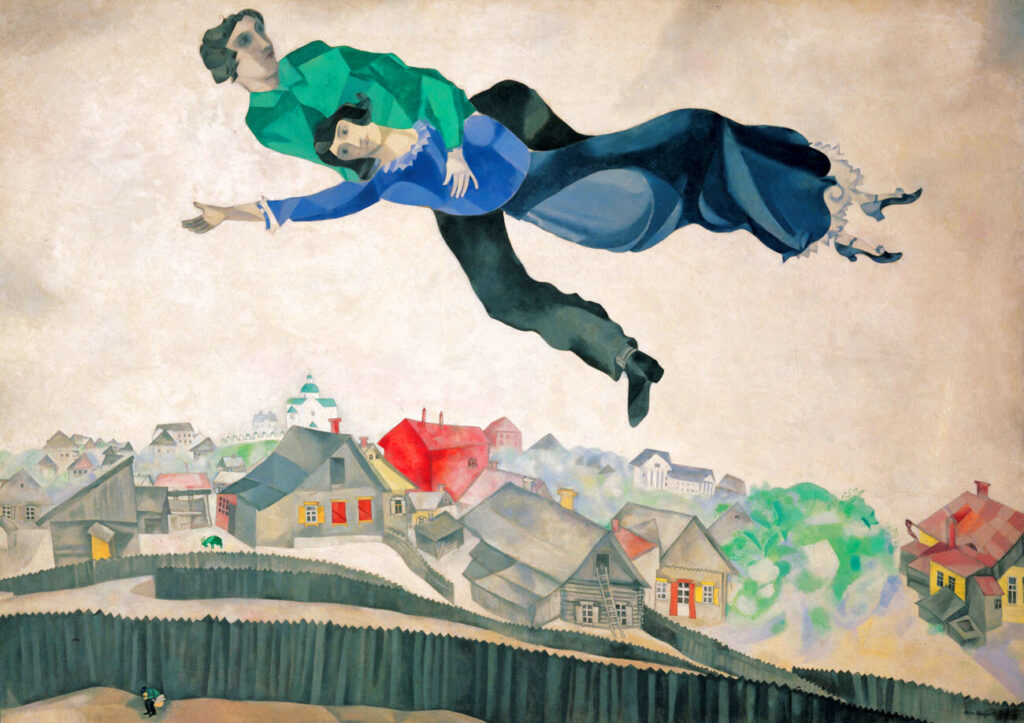
As a teenager, he obtained permission to study in St. Petersburg, something rare for Jews at the time. There, he received a scholarship that allowed him to attend a prestigious art school, where he studied under the painter Leon Bakst. Although his family was very religious, they supported his desire to explore art without iconographic constraints, always emphasizing the human figure. It was during this period that he met Bella Rosenfeld, who would later become his wife.
In 1910, Chagall left for Paris in search of new horizons. Life in the French capital was marked by financial difficulties, but also by intense learning. He came into contact with movements such as Impressionism, Cubism, Fauvism, and Surrealism. Even so, he maintained his own style, marked by memories of Vitebsk, its wooden houses, churches, and characters.
In the spring of 1914, with the help of the poet Apollinaire, he held his first solo exhibition in Berlin. Before returning to France, he took the opportunity to visit Russia and reunite with his family and Bella. However, the outbreak of World War I closed the borders, and he remained in his native country for eight years, during which time he produced a great deal of work and got married.
With the Bolshevik Revolution, Chagall took on the role of Commissioner of Fine Arts in Vitebsk. However, he struggled to adapt his art to the regime’s demands. He moved to Moscow with his wife and daughter, but soon managed to return to Paris, a city that became his second home. There, his career gained momentum. French poets saw poetry in his canvases, which depicted lovers, flowers, circus scenes, and, always, memories of Vitebsk.
In the 1930s, his work took on darker tones, reflecting the advance of Nazism in Europe. Solitude and Jewish themes gained prominence, and red came to dominate his palette, symbolizing threat and violence. When the Nazis invaded France, Chagall went into exile in New York, where he remained throughout the war. His creativity suffered during this period, marked by anguish. In 1944, he lost Bella to a mysterious virus, which plunged him into deep depression.
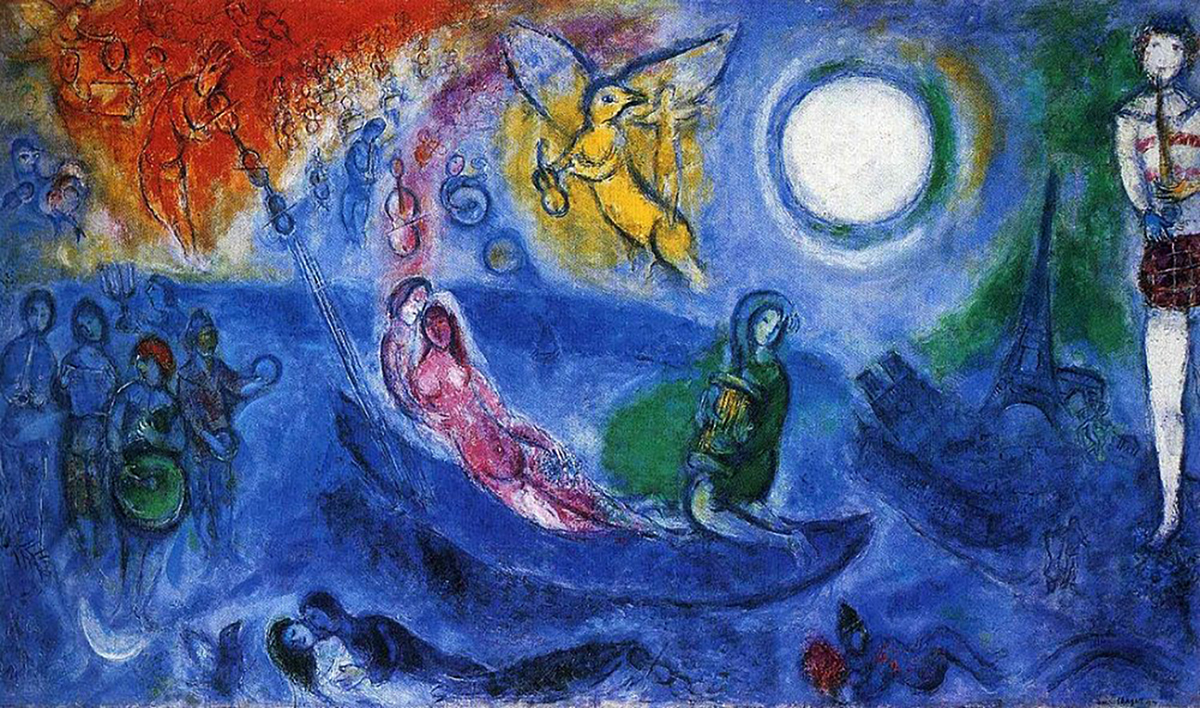
After 25 years of creative work, Chagall returned to Paris in 1948. He continued to depict Vitebsk, lovers, animals that symbolized people, flowers, and the figure of Christ. He also incorporated the Eiffel Tower into his imagery. He married again, this time to Valentina Brodsky (Vava), and moved to the south of France. He also devoted himself to printmaking, exploring biblical themes, and to stained glass, which he created for both churches and synagogues. Alongside Picasso, he discovered ceramics, which he practiced until the end of his life.
Marc Chagall passed away in 1985, leaving behind a vast and profoundly human body of work, marked by poetry, spirituality, and memory. In the city of Nice (France), there is a beautiful museum housing many of his works.